What floor screed costs in Ireland
Floor screed in Ireland runs about €22–€34 a m² in sand and cement, supplied and laid, and €24–€36 a m² in liquid screed, poured. A 40 m² extension comes to €880–€1,360 in sand and cement. A 75 m² ground floor comes to €1,650–€2,550. One room is priced on the call, because a small floor carries a minimum charge.
The rate per m², what a whole floor comes to, and the things that push a price up or down.
Free, no obligation. One local screeder prices it, not five.
- €22–€34/m²sand and cement, laid
- €24–€36/m²liquid screed, poured
- €1,650–€2,55075 m² ground floor, sand and cement
- €14.6425 kg bag of screed, with VAT

Our price guide
For a house floor, with the screed supplied and laid by the contractor.
Sand and cement screed
€22–€34/m²mixed semi-dry, laid and trowelled by hand- One roomOn the call
- 40 m² extension€880–€1,360
- 75 m² ground floor€1,650–€2,550
- 110 m² house€2,420–€3,740
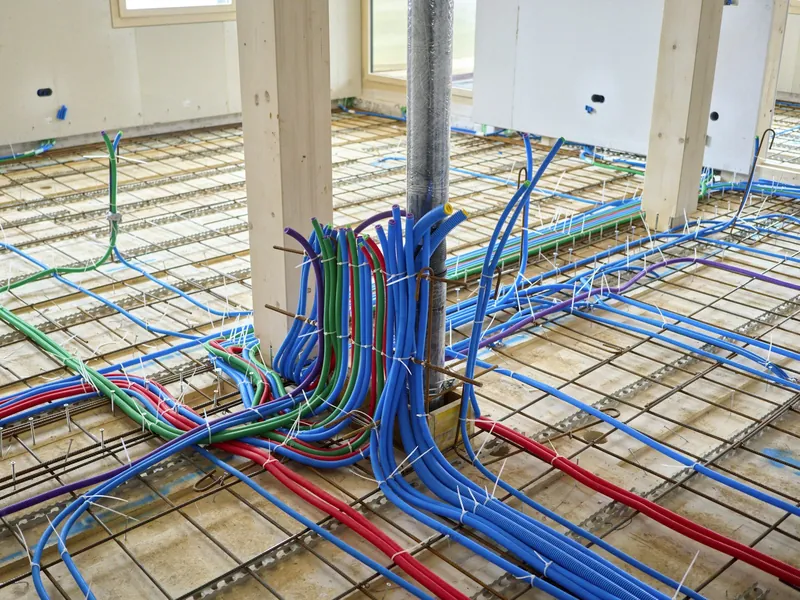
Liquid screed
€24–€36/m²pumped in from a lorry and levelled with a dappling bar- One roomOn the call
- 40 m² extension€960–€1,440
- 75 m² ground floor€1,800–€2,700
- 110 m² house€2,640–€3,960
One room by the bag
€14.64 a bag25 kg of bagged sand and cement screed, with VAT- Without VAT€11.90
- Weight of 1 m² at 50 mm105–110 kg
- Bags for 1 m² at 50 mm4 to 5
Totals at 40, 75 and 110 m²
Sand and cement
- Rate
- €22–€34/m²
- 40 m²
- €880–€1,360
- 75 m²
- €1,650–€2,550
- 110 m²
- €2,420–€3,740
Liquid screed
- Rate
- €24–€36/m²
- 40 m²
- €960–€1,440
- 75 m²
- €1,800–€2,700
- 110 m²
- €2,640–€3,960
The totals are the area multiplied by the rate. A floor under 25 m² is not priced that way. The lorry, the pump and the crew cost the same for a small floor as for a big one, so a small job carries a minimum charge. The screeder gives you that figure on the call.
Price your screed
Four taps and the guide price is on screen. Your name and number come last, and only if you want a local screeder to price the floor properly.
Screed for an extension floor, about 40 m², in sand and cement: €880 to €1,360, supplied and laid.
How the price is worked out
It is the area multiplied by our guide rate: €22 to €34 a m² for sand and cement screed supplied and laid, and €24 to €36 a m² for liquid screed poured. One room under 25 m² is not priced by the m², because the pump, the crew and the delivery cost the same for a small floor as for a big one. Insulation, membranes, underfloor heating pipes and any digging out are separate lines. The screeder gives the firm price after seeing the drawings or the floor.
Seven things that move the price
- Depth. A 75 mm screed uses half as much material again as a 50 mm one. Depth is set by what is under it. See how thick, job by job.
- Area. The rate per m² falls as the floor gets bigger, because the set-up cost is spread wider.
- Access. A pump at the front door with a short hose is quick. A terraced house with the only way in through the hall is slower.
- Sand and cement or liquid. Liquid costs a little more per m² but goes down thinner and faster.
- Fibres or mesh. Fibres in the mix or a light mesh help against cracking. Ask whether they are in the rate.
- Falls. A floor shaped to a drain takes longer than a flat one.
- Distance. Liquid screed is batched at a plant. A long drive from the plant adds to the load.
What is usually not in a screed price
A screeder prices the screed. These are normally somebody else's line on the job, so check who has them.
- The insulation boards under the screed, and laying them.
- The membrane over the insulation and the edge strip round the walls.
- Underfloor heating pipes, the manifold and the pressure test.
- Digging out an old floor, hardcore, the radon barrier and the concrete slab.
- Sanding the surface skin off a calcium sulphate liquid screed before tiling.
- Moisture testing before the floor finish goes down.
The order those layers go in is set out in what is under the screed.
Eight things a screed quote should say
Two quotes can only be compared when both say all eight.
- The area in m². Measured off the drawings or the floor, room by room, so you can check it.
- The depth in millimetres. A price with no depth on it cannot be compared with another one.
- The screed by name. Sand and cement, with fibres or without, or liquid, and whether that is cement-based or calcium sulphate.
- What it sits on. Stuck to the slab, on a membrane, or on insulation. Each has its own least depth.
- What is not in it. Insulation, membranes, edge strip and heating pipes are often someone else's job. The quote should say whose.
- How it gets in. Where the pump or the mixer stands, and how far the hose has to run.
- VAT. Building work is charged at 13.5%. The quote should say whether that is in the figure.
- The drying time. How long before you can walk on it, load it, turn on the heat and lay the floor.
Asked before the pour
How much is screed per m² in Ireland?
About €22–€34 a m² for sand and cement screed, supplied and laid, and €24–€36 a m² for liquid screed, poured.
How much does it cost to screed a 40 m² extension?
About €880–€1,360 in sand and cement or €960–€1,440 in liquid screed. Insulation, membrane and heating pipes are separate.
How much does it cost to screed a whole house?
A 110 m² house comes to about €2,420–€3,740 in sand and cement or €2,640–€3,960 in liquid screed.
Why is one room not priced by the m²?
The lorry, the pump and the crew cost the same whether the floor is 12 m² or 60 m². Screeders set a minimum charge for small floors and tell you it on the call.
What does a bag of floor screed cost?
A 25 kg bag of sand and cement screed is about €11.90 without VAT and €14.64 with it. A square metre at 50 mm deep weighs 105–110 kg, so it takes four to five bags.
Is VAT included in a screed price?
Ask. Building work is charged at 13.5% VAT, and a quote should say whether the figure includes it.
Everything on screed.ie
Screed by job
Before and after the pour
See the price before anyone rings
Tap the job, the area and the screed. If the figure suits, a single screeding contractor in your county rings you and prices the floor properly.